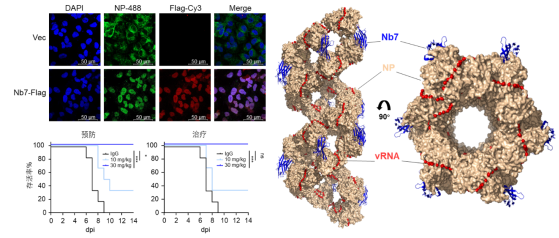
The Team for Molecular Ecology of Animal Viruses at the Lanzhou Veterinary Research Institute (LVRI), Chinese Academy of Agricultural Sciences (CAAS), recently released a significant breakthrough in the development of broad-spectrum antiviral strategies against influenza A viruses (IAVs). The study, titled “Broad-spectrum inhibition of influenza A virus replication by blocking the nuclear export of viral ribonucleoprotein complexes,” has been published in the Journal of Virology. Given the ongoing threat of IAVs and the limitations of current control strategies caused by viral mutation, the team focused on the highly conserved nucleoprotein (NP) as a promising antiviral target. They successfully screened a high-affinity nanobody, Nb7, which specifically recognizes NP, and found that it broadly inhibits the replication of various IAV strains. Mechanistically, the study showed that Nb7 blocks the nuclear export of viral ribonucleoprotein (vRNP) complexes by binding to the nuclear export sequence 1 (NES1) region of the NP, thereby suppressing the assembly of progeny virions. Furthermore, the conserved residues Q42, E46, and K48 within the NES1 were identified as key sites required for Nb7 binding. Notably, Nb7 fused with a trans-activating transduction peptide (TAT) provided full protection against lethal IAV infection under prophylactic and therapeutic treatment. This work offers new insight into the nuclear export of IAV-vRNPs and contributes to the development of broad-spectrum antiviral strategies. The first authors of this work are Wentao Shen, Jie Xu and Zhaoshan Chen, the postgraduate students at LVRI, CAAS. Professor Qiyun Zhu and associate professor Shuai Xu at LVRI serve as the corresponding authors. This study was supported by funding from the National Natural Science Foundation of China (323B2060 to W.S., 32172820 to S.X., and U23A20243 and 32272972 to Q.Z.), the Science and Technology Major Project of Gansu Province (23JRRA1513, 24JRRA806 to Q.Z.; 22ZD6NA001 and 25JRRA1124 to S.X.), the Science and Technology Project of Lanzhou City (Grant 2024-2-15), and the Youth Innovation Program of the Chinese Academy of Agricultural Sciences (Y2023QC30 to S.X.). The full article can be accessed through the link: https://journals.asm.org/doi/10.1128/jvi.01478-25